Use Finder
Part 7B. Alternate Typologies
Div. 7B.1. Institutional
Sec. 7B.1.1. Civic Institution 1
Eligible Districts
Form
Frontage
Standard
Use
Density
All
All
5
All
All
Intent
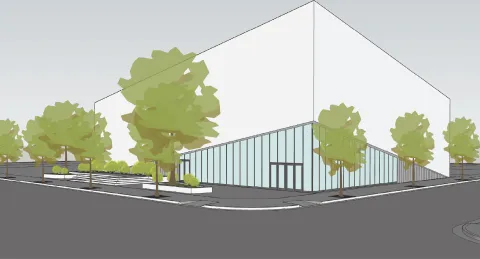
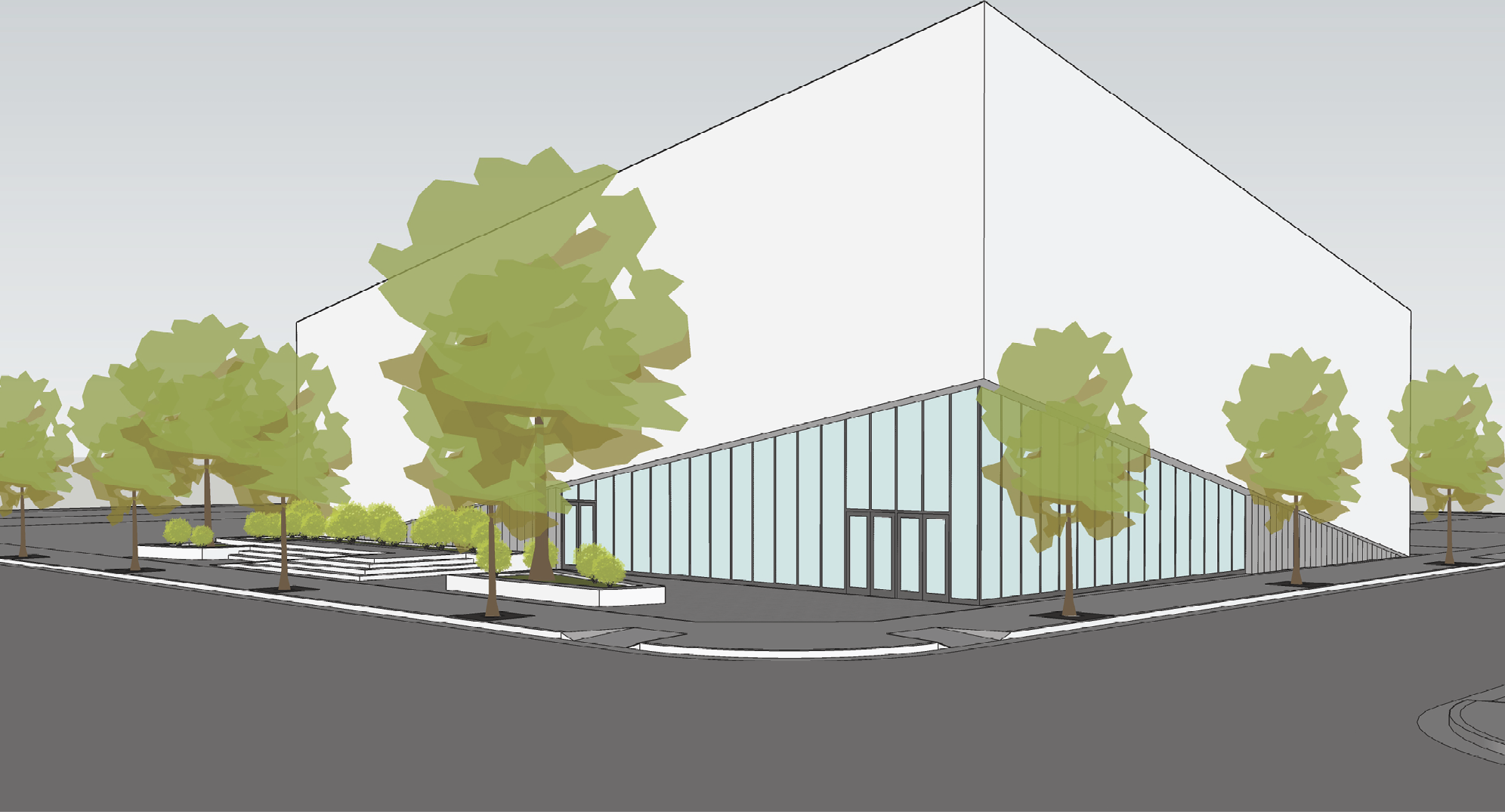
The Civic Institution 1 Alternate Typology is intended to promote placemaking through architectural monuments and publicly accessible spaces. This Alternate Typology allows greater design flexibility for civic institutions to differentiate civic assets from the surrounding urban fabric, while maintaining standards essential for ensuring all projects actively contribute to a highly walkable urban environment.
Review
Administrative review is required, see Sec. 13B.3.1. (Administrative Review).
Form Standards
Lot Parameters
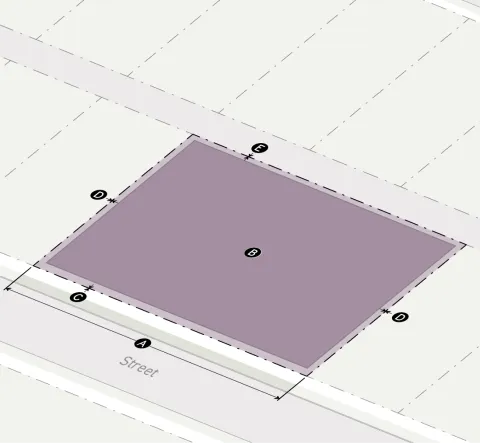
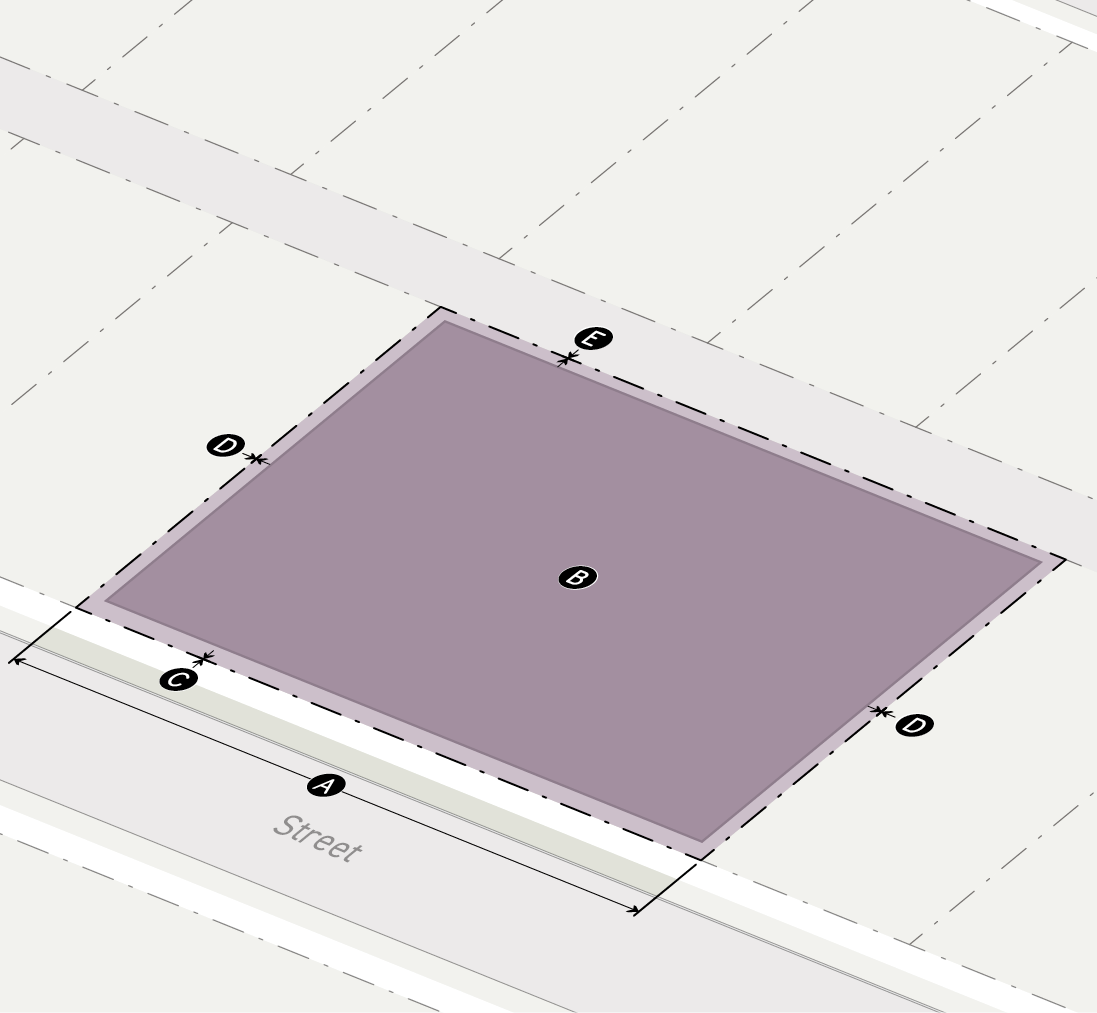
a. LOT SIZE
Lot area (min)
n/a
A
Lot width (min)
25'
b. COVERAGE
B
Building coverage (max)
95%
Building setbacks
C
Primary street (min)
0'
Side street (min)
0'
D
Side (min)
0'
Rear (min)
0'
E
Alley (min)
0'
Special lot line (min)
0'
c. AMENITY
Lot amenity space (min)
n/a
Residential amenity space (min)
n/a
Bulk and Mass
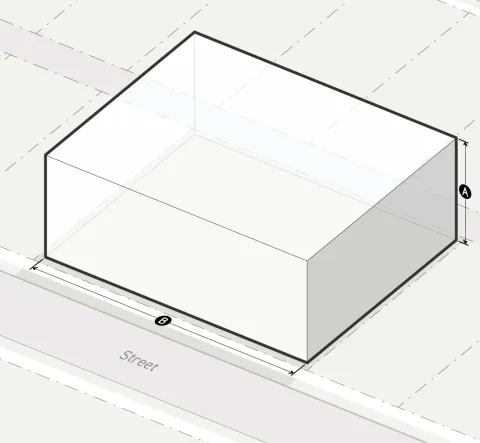
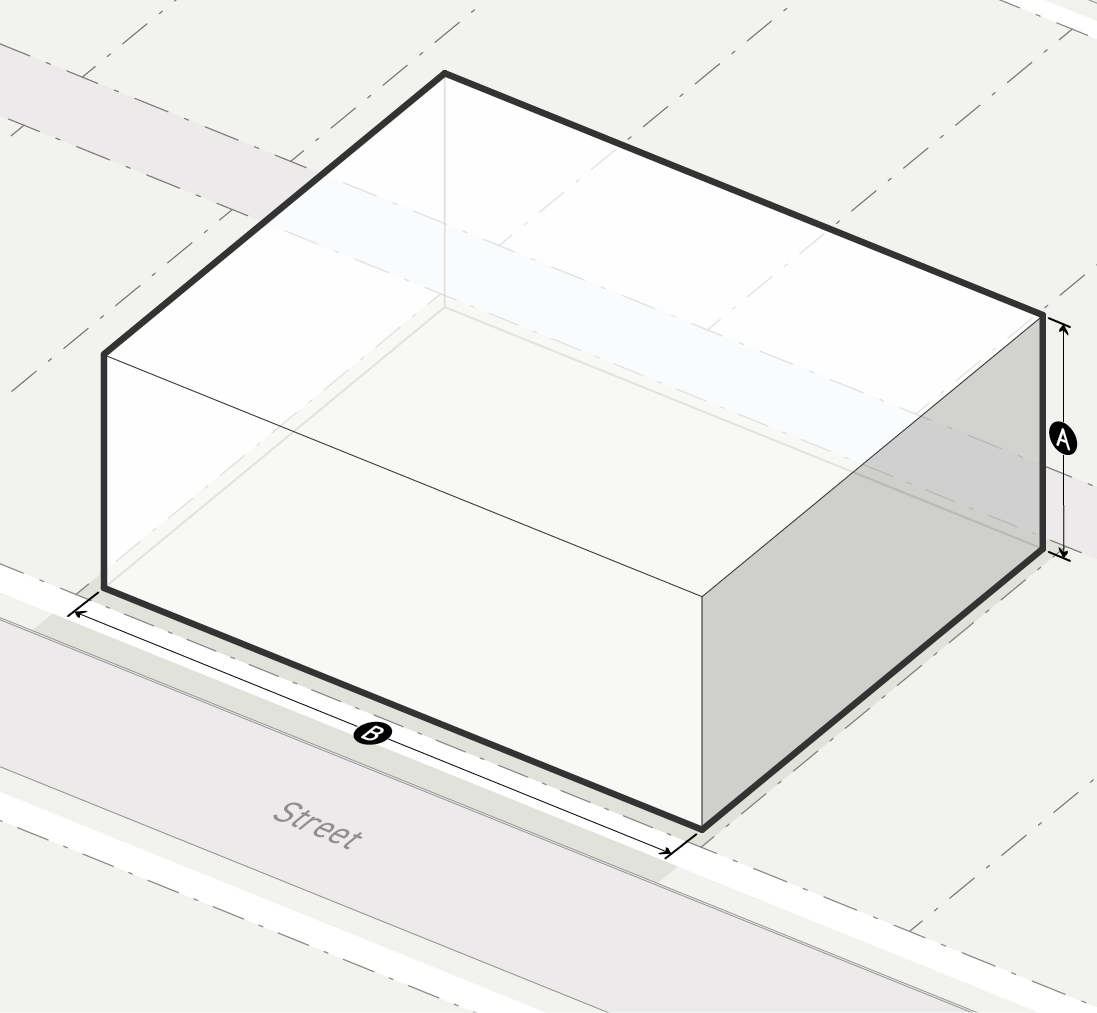
a. HEIGHT & FAR
FAR (max)
Set by Form District
A
Height (max)
n/a
b. UPPER-STORY BULK
Set by Form District
c. BUILDING MASS
Set by Form District
Frontage Standards
Site
Primary St.
Side St.
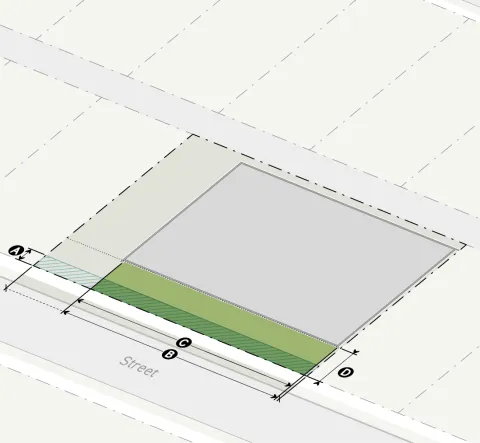
a. BUILD-TO
Applicable stories (min)
1
1
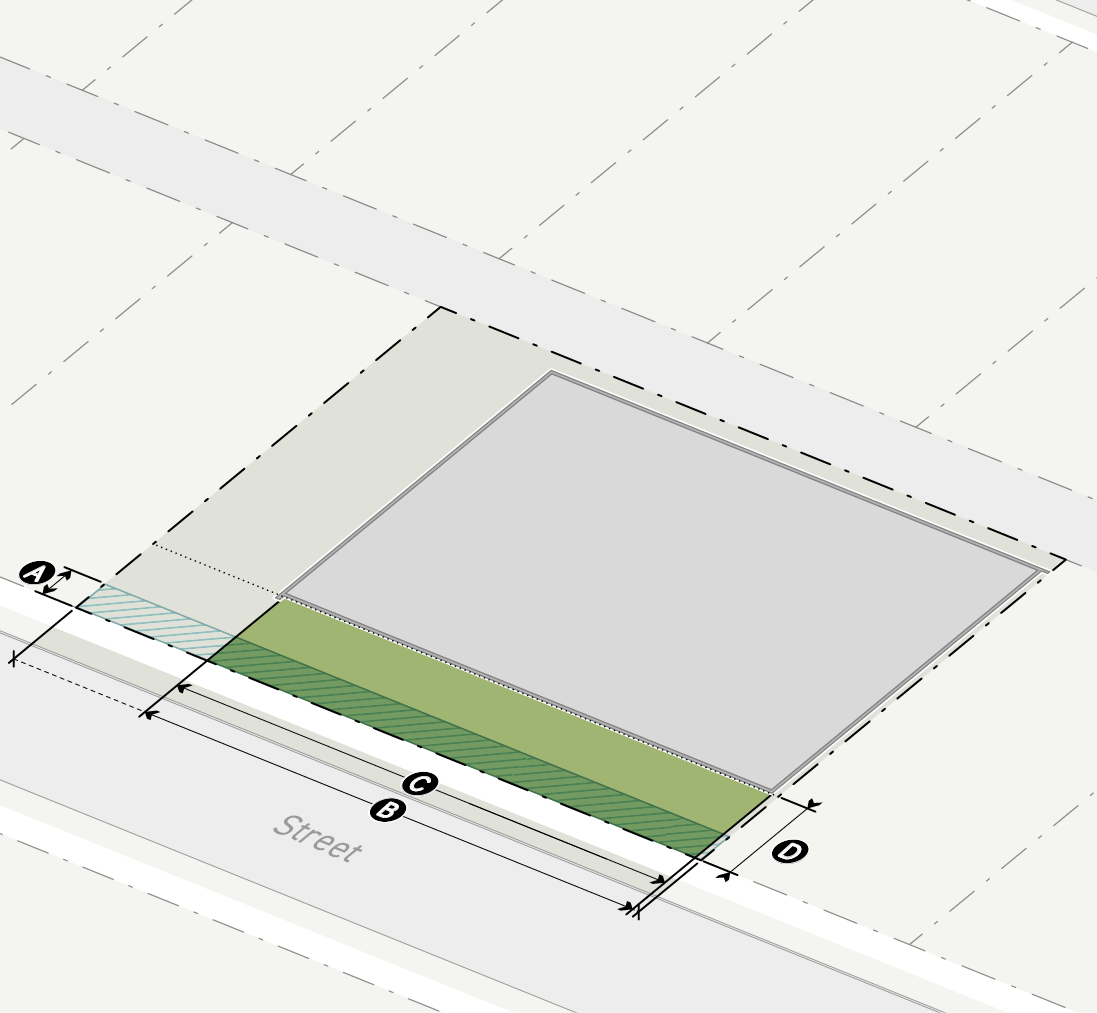
A
Build-to depth (max)
0'/10'
0'/10'
B
Build-to width (min)
80%
60%
C
Pedestrian amenity allowance (max)
100%
100%
b. PARKING
D
Parking setback (min)
25'
0'
Parking between building & street (allowed)
No
No
c. LANDSCAPE
Frontage planting area (min)
n/a
n/a
Frontage yard fence & wall type allowed:
A3*
A3*
*Fences and walls may not be located between the building face meeting the required build-to width and the street.
Facade
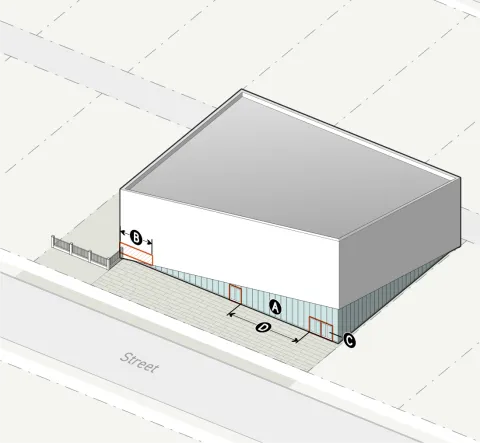
Primary St.
Side St.
a. TRANSPARENCY
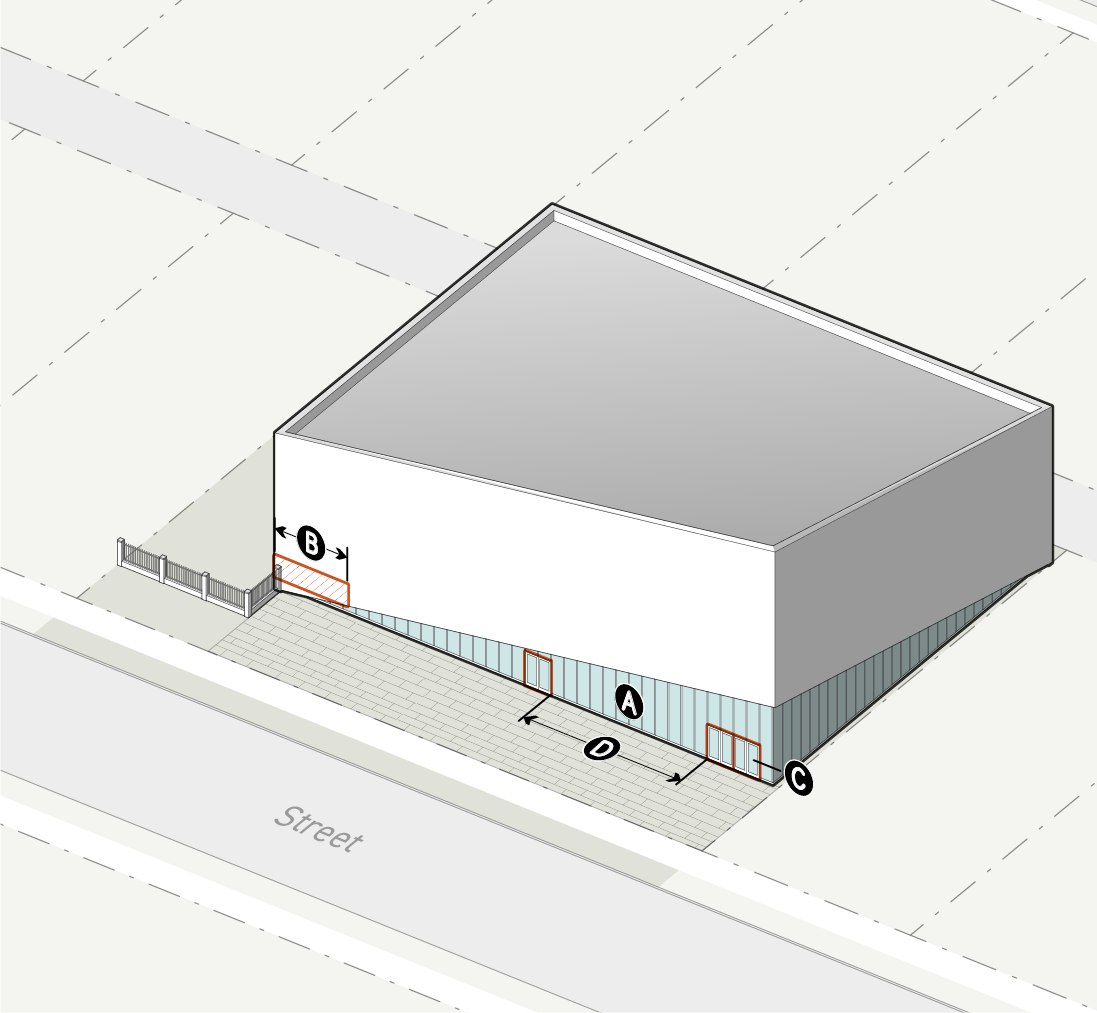
A
Ground story (min)
10%*
10%*
Upper stories (min)
n/a
n/a
B
Active wall spacing (max)
70’
90'
b. ENTRANCES
C
Street-facing entrance
Required
n/a
D
Entrance spacing (max)
100’
150'
Entry feature
n/a
n/a
c. GROUND STORY
Ground story height (min)
Residential (min)
n/a
n/a
Non-residential (min)
16'
16'
Ground floor elevation (min/max)
n/a
n/a
*Ground story window and door glazing may be screened for up to 50 percent of the glazed area.
Development Standards
Set by the applied Development Standard District (Part 4B.).
Use Standards
For a minimum of 20 years after the issuance of a Certificate of Occupancy, no less than 75 percent of the total floor area on the lot shall be designated for one or more of the following uses:
Once 20 years have elapsed, any use allowed in the applied Use District (Part 5B.) is permitted.
For additional Use District standards, see the applied Use District (Part 5B.).
Density Standards
Set by the applied Density District (Part 6B.).
Div. 7B.2. Corner Store
[Reserved].
Div. 7B.3. Small Lot Subdivision
[Reserved].
Div. 7B.4. Drive-Through
[Reserved].
Div. 7B.5. Fueling Station
[Reserved].
Div. 7B.6. Opportunity Corridors
Sec. 7B.6.1. Opportunity Corridors 1A
Eligibility
Eligible Districts
Form
Frontage
Standard
Use
Density
All
All
All
A_, RG_, RX_
2L, 3L, 4L, 2, 3, 4, 6, 8, 10, 12, 15, 20, 25, 30, 40, 50, 60, FA
Eligible Projects
In order to be eligible to use the Opportunity Corridors 1A Alternate Typology, a project must be on a lot, in whole or in part, mapped in the OC-1 Opportunity Corridors Incentive Set on the Mixed Income Housing Incentive Map (Sec. 1.5.17.), and must be utilizing, and meeting all requirements of, Sec. 9.2.3. (Opportunity Corridors Housing Incentive Program).
Intent
The Opportunity Corridors 1A Alternate Typology is intended to establish a package of alternative standards for housing projects to encourage the provision of restricted affordable units in exchange for incentives such as additional allowable floor area and height in order to increase the feasibility of construction. The alternate typology facilitates the Opportunity Corridors Housing Incentive Program (Sec. 9.2.3.) and establishes the citywide baseline standards for mixed-income housing projects that are appropriate along major streets with transit service.
Review
Projects shall be subject to the applicable review procedures in Subsection D. (Administration) of Sec. 9.2.3. (Opportunity Corridors Housing Incentive Program).
Form Standards
Projects shall utilize the Form standards provided in the tables below, as applicable.
Lot Parameters
a. LOT SIZE
Lot area (min)
Set by Form District
Lot width (min)
Set by Form District
b. COVERAGE
Building coverage (max)
Set by Form District
Building setbacks
Set by Form District
Permeable Surface (min)
Set by Form District
c. AMENITY
Lot amenity space (min)
Set by Form District
Residential amenity space (min)
Set by Form District
Bulk and Mass
a. FAR & HEIGHT
Base FAR (max)
Set by Form District
Base Height in Stories (max)
Set by Form District
Tier 1 Bonus FAR (max)
4.0
Tier 1 Bonus Height in Stories (max)
6 stories
Tier 2 Bonus FAR (max)
7.0 or
Tier 2 Bonus Height in Stories (max)
9 stories
b. BUILDING MASS
Building width (max)
Base Building Width
Set by Form District
Bonus Building Width
160'
Building Break (min)
15'
c. UPPER-STORY BULK
Street Step-Back
Set by Form District
District Boundary Height Transition
Set by Form District
In lieu of the floor area ratio and height standards in Paragraph 2. (Bulk and Mass), above, a project may use the following standards, as applicable:
A tier 1 bonus floor area ratio of up to a 45 percent increase in the base floor area ratio in the applied Form District (Part 2B.), or applicable Supplemental District, Specific Plan, or Special Zone, and a tier 1 bonus height in stories of one additional story of height beyond the base height in the applied Form District (Part 2B.), or applicable Supplemental District, Specific Plan or Special Zone.
A tier 2 bonus floor area ratio of up to an additional 3.0 FAR on top of the applicable tier 1 bonus floor area ratio in Paragraph 2. (Bulk and Mass), above, or Subparagraph a., above, and a tier 2 bonus height in stories of an additional three stories beyond the applicable tier 1 bonus height, in Paragraph 2. (Bulk and Mass), above, or Subparagraph a., above.
Regardless of Paragraph 1. (Lot Parameters), Paragraph 2. (Bulk and Mass) and Paragraph 3., above, a project on a site with a designated historic resource or a non-contributor shall be subject to the following standards:
Unless a project utilizes eligible public benefits incentives pursuant to Sec. 9.2.3.C.5. (Public Benefits) of the Opportunity Corridors Housing Incentive Program, the maximum FAR shall be limited to the base FAR of the applied Form District (Part 2B.).
Unless a project utilizes eligible public benefits incentives pursuant to Sec. 9.2.3.C.5. (Public Benefits) of the Opportunity Corridors Housing Incentive Program, the maximum height shall be up to one additional story above the base height in stories, and up to an additional 11 feet above the base height in feet, of the applied Form District (Part 2B.).
Frontage Standards
Set by applied Frontage District (Part 3B.).
Development Standards
Set by the applied Development Standards District (Part 4B.) except as provided in Paragraph 2. (Required Automobile Parking Stalls), below.
Required Automobile Parking Stalls
No automobile parking shall be required for residential uses.
Use Standards
Set by the applied Use District (Part 5B.).
Density Standards
The maximum density shall be the density allowed in an FA Density District, pursuant to Div. 6B.2. (Lot Area-Based Density Districts).
Sec. 7B.6.2. Opportunity Corridors 1B
Eligibility
Eligible Districts
Form
Frontage
Standard
Use
Density
All
All
All
CX_, IX_, P_
2L, 3L, 4L, 2, 3, 4, 6, 8, 10, 12, 15, 20, 25, 30, 40, 50, 60, FA
Eligible Projects
In order to be eligible to use the Opportunity Corridors 1B Alternate Typology, a project must be on a lot mapped in the OC-1 Opportunity Corridors Incentive Set on the Mixed Income Housing Incentive Map (Sec. 1.5.17.), and must be utilizing, and meeting all requirements of, Sec. 9.2.3. (Opportunity Corridors Housing Incentive Program).
Intent
The Opportunity Corridors 1B Alternate Typology is intended to establish a package of alternative standards for housing projects to encourage the provision of restricted affordable units in exchange for incentives such as additional allowable floor area and height in order to increase the feasibility of construction. The alternate typology facilitates the Opportunity Corridors Housing Incentive Program (Sec. 9.2.3.), and establishes the citywide baseline standards for mixed-income housing projects along major streets with transit service.
Review
Projects shall be subject to the applicable review procedures in Subsection D. (Administration) of Sec. 9.2.3. (Opportunity Corridors Housing Incentive Program).
Form Standards
Projects shall utilize the Form standards provided in the tables below, as applicable.
Lot Parameters
a. LOT SIZE
Lot area (min)
Set by Form District
Lot width (min)
Set by Form District
b. COVERAGE
Building coverage (max)
Set by Form District
Building setbacks
Set by Form District
Permeable Surface (min)
Set by Form District
c. AMENITY
Lot amenity space (min)
Set by Form District
Residential amenity space (min)
Set by Form District
Bulk and Mass
a. FAR & HEIGHT
Base FAR (max)
Set by Form District
Base Height in Stories (max)
Set by Form District
Tier 1 Bonus FAR (max)
4.5
Tier 1 Bonus Height in Stories (max)
7 stories
Tier 2 Bonus FAR (max)
7.5
Tier 2 Bonus Height in Stories (max)
10 stories
b. BUILDING MASS
Building width (max)
Base Building Width
Set by Form District
Bonus Building Width
210'
Building Break (min)
25'
c. UPPER-STORY BULK
Street Step-Back
Set by Form District
District Boundary Height Transition
Set by Form District
In lieu of the floor area ratio and height standards in Paragraph 2. (Bulk and Mass), above, a project may use the following standards, as applicable:
A tier 1 bonus floor area ratio of up to a 50 percent increase in the base floor area ratio in the applied Form District (Part 2B.), or applicable Supplemental District, Specific Plan, or Special Zone, and a tier 1 bonus height in stories of one additional story of height beyond the base height in the applied Form District (Part 2B.), or applicable Supplemental District, Specific Plan or Special Zone.
A tier 2 bonus floor area ratio of up to an additional 3.0 FAR on top of the applicable tier 1 bonus floor area ratio in Paragraph 2. (Bulk and Mass), above, or Subparagraph a., above, and a tier 2 bonus height in stories of an additional three stories beyond the applicable tier 1 bonus height in stories, in Paragraph 2. (Bulk and Mass), above, or Subparagraph a., above.
Regardless of Paragraphs 1. (Lot Parameters), Paragraph 2. (Bulk and Mass), and Paragraph 3., above, a project on a site with a designated historic resource or a non-contributor shall be subject to the following standards:
Unless a project utilizes public benefits incentives pursuant to Sec. 9.2.3.C.5. (Public Benefits) of the Opportunity Corridors Housing Incentive Program, the maximum FAR shall be limited to the base FAR of the applied Form District (Part 2B.).
Unless a project utilizes public benefits incentives pursuant to Sec. 9.2.3.C.5. (Public Benefits) of the Opportunity Corridors Housing Incentive Program, the maximum height shall be up to one additional story above the base height in stories, and up to 11 additional feet above base height in feet, of the applied Form District (Part 2B.).
Frontage Standards
Set by applied Frontage District (Part 3B.).
Development Standards
Set by the applied Development Standards District (Part 4B.) except as provided in Paragraph 2. (Required Automobile Parking Stalls), below.
Required Automobile Parking Stalls
No automobile parking shall be required for residential uses.
Use Standards
Set by the applied Use District (Part 5B.).
Density Standards
The maximum density shall be the density allowed in an FA Density District, pursuant to Div. 6B.2. (Lot Area-Based Density Districts).
Sec. 7B.6.3. Opportunity Corridors 2A
Eligibility
Eligible Districts
Form
Frontage
Standard
Use
Density
All
All
All
A_, RG_, RX_
2L, 3L, 4L, 2, 3, 4, 6, 8, 10, 12, 15, 20, 25, 30, 40, 50, 60, FA
Eligible Projects
In order to be eligible to use the Opportunity Corridors 2A Alternate Typology, a project must be on a lot mapped in the OC-2 Opportunity Corridors Incentive Set on the Mixed Income Housing Incentive Map (Sec. 1.5.17.), and must be utilizing, and meeting all the requirements of, Sec. 9.2.3. (Opportunity Corridors Housing Incentive Program).
Intent
The Opportunity Corridors 2A Alternate Typology is intended to establish a package of alternative standards for housing projects to encourage the provision of restricted affordable units in exchange for incentives such as additional allowable floor area and height in order to increase the feasibility of construction. The alternate typology facilitates the Opportunity Corridors Housing Incentive Program (Sec. 9.2.3.), and establishes the citywide baseline standards for mixed-income housing projects along major streets with transit service.
Review
Projects shall be subject to the applicable review procedures in Subsection D. (Administration) of Sec. 9.2.3. (Opportunity Corridors Housing Incentive Program).
Form Standards
Projects shall utilize the Form standards provided in the tables below, as applicable.
Lot Parameters
a. LOT SIZE
Lot area (min)
Set by Form District
Lot width (min)
Set by Form District
b. COVERAGE
Building coverage (max)
Set by Form District
Building setbacks
Set by Form District
Permeable Surface (min)
Set by Form District
c. AMENITY
Lot amenity space (min)
Set by Form District
Residential amenity space (min)
Set by Form District
Bulk and Mass
a. FAR & HEIGHT
Base FAR (max)
Set by Form District
Base Height in Stories (max)
Set by Form District
Tier 1 Bonus FAR (max)
4.5
Tier 1 Bonus Height in Stories (max)
7 stories
Tier 2 Bonus FAR (max)
7.5
Tier 2 Bonus Height in Stories (max)
10 stories
b. BUILDING MASS
Building width (max)
Base Building Width
Set by Form District
Bonus Building Width
160'
Building Break (min)
15'
c. UPPER-STORY BULK
Street Step-Back
Set by Form District
District Boundary Height Transition
Set by Form District
In lieu of the floor area ratio and height standards in Paragraph 2. (Bulk and Mass), above, a project may use the following standards, as applicable:
A tier 1 bonus floor area ratio of up to a 50 percent increase in the base floor area ratio in the applied Form District (Part 2B.), or applicable Supplemental District, Specific Plan, or Special Zone, and a tier 1 bonus height in stories of one additional story of height beyond the base in the applied Form District (Part 2B.), or applicable Supplemental District, Specific Plan or Special Zone.
A tier 2 bonus floor area ratio up to an additional 3.0 FAR on top of the applicable tier 1 bonus floor area ratio in Paragraph 2. (Bulk and Mass), above, or Subparagraph a., above, and a tier 2 bonus height in stories of an additional three stories beyond the applicable tier 1 bonus height in Paragraph 2. (Bulk and Mass), above, or Subparagraph a., above.
Regardless of the Paragraph 1. (Lot Parameters), Paragraph 2. (Bulk and Mass) and Paragraph 3., above, a project on a site with a designated historic resource or a non-contributor shall be subject to the following standards:
Unless a project utilizes public benefits incentives pursuant to Sec. 9.2.3.C.5. (Public Benefits) of the Opportunity Corridors Housing Incentive Program, the maximum FAR shall be limited to the base FAR of the applied Form District (Part 2B.).
Unless a project utilizes public benefits incentives pursuant to Sec. 9.2.3.C.5. (Public Benefits) of the Opportunity Corridors Housing Incentive Program, the maximum height shall be up to one additional story above the base height in stories, and up to an additional 11 feet above the base height in feet, of the applied Form District (Part 2B.).
Frontage Standards
Set by applied Frontage District (Part 3B.).
Development Standards
Set by the applied Development Standards District (Part 4B.) except as provided in Paragraph 2. (Required Automobile Parking Stalls), below.
Required Automobile Parking Stalls
No automobile parking shall be required for residential uses.
Use Standards
Set by the applied Use District (Part 5B.).
Density Standards
The maximum density shall be the density allowed in an FA Density District, pursuant to Div. 6B.2. (Lot Area-Based Density Districts).
Sec. 7B.6.4. Opportunity Corridors 2B
Eligibility
Eligible Districts
Form
Frontage
Standard
Use
Density
All
All
All
CX_, IX_, P_
2L, 3L, 4L, 2, 3, 4, 6, 8, 10, 12, 15, 20, 25, 30, 40, 50, 60, FA
Eligible Projects
In order to be eligible to use the Opportunity Corridors 2B Alternate Typology, a project must be on a lot mapped in the OC-2 Opportunity Corridors Incentive Set on the Mixed Income Housing Incentive Map (Sec. 1.5.17.), and must be utilizing, and meeting all requirements of, Sec. 9.2.3. (Opportunity Corridors Housing Incentive Program).
Intent
The Opportunity Corridors 2B Alternate Typology is intended to establish a package of alternative standards for housing projects to encourage the provision of restricted affordable units in exchange for incentives such as additional allowable floor area and height in order to increase the feasibility of construction. The alternate typology facilitates the Opportunity Corridors Housing Incentive Program (Sec. 9.2.3.), and establishes the citywide baseline standards for mixed-income housing projects along major streets with transit service.
Review
Projects shall be subject to the applicable review procedures in Subsection D. (Administration) of Sec. 9.2.3. (Opportunity Corridors Housing Incentive Program).
Form Standards
Projects shall utilize the Form standards provided in the tables below, as applicable.
Lot Parameters
a. LOT SIZE
Lot area (min)
Set by Form District
Lot width (min)
Set by Form District
b. COVERAGE
Building coverage (max)
Set by Form District
Building setbacks
Set by Form District
Permeable Surface (min)
Set by Form District
c. AMENITY
Lot amenity space (min)
Set by Form District
Residential amenity space (min)
Set by Form District
Bulk and Mass
a. FAR & HEIGHT
Base FAR (max)
Set by Form District
Base Height in Stories (max)
Set by Form District
Tier 1 Bonus FAR (max)
4.75
Tier 1 Bonus Height in Stories (max)
7 stories
Tier 2 Bonus FAR (max)
7.75
Tier 2 Bonus Height in Stories (max)
10 stories
b. BUILDING MASS
Building width (max)
Base Building Width
Set by Form District
Bonus Building Width
210'
Building Break (min)
25'
c. UPPER-STORY BULK
Street Step-Back
Set by Form District
District Boundary Height Transition
Set by Form District
In lieu of the floor area ratio and height standards in Paragraph 2. (Bulk and Mass), above, a project may use the following standards:
A tier 1 bonus floor area ratio of up to a 55 percent increase in the base floor area ratio in the applied Form District (Part 2B.), or applicable Supplemental District, Specific Plan, or Special Zone, and a tier 1 bonus height in stories of one additional story of height beyond the base height in the applied Form District (Part 2B.), or applicable Supplemental District, Specific Plan or Special Zone.
A tier 2 bonus floor area ratio of up to an additional 3.0 FAR on top of the applicable tier 1 bonus floor area ratio in Paragraph 2. (Bulk and Mass), above, or Subparagraph a., above, and a tier 2 bonus height in stories of an additional three stories beyond the applicable tier 1 bonus height in stories, in Paragraph 2. (Bulk and Mass), above, or Subparagraph a., above.
Regardless of Paragraph 1. (Lot Parameters), Paragraph 2. (Bulk and Mass) and Paragraph 3., above, a project on a site with a designated historic resource or a non-contributor shall be subject to the following standards:
Unless a project utilizes public benefits incentives pursuant to Sec. 9.2.3.C.5. (Public Benefits) of the Opportunity Corridors Housing Incentive Program, the maximum FAR shall be limited to the base FAR of the applied Form District (Part 2B.).
Unless a project utilizes public benefits incentives pursuant to Sec. 9.2.3.C.5. (Public Benefits) of the Opportunity Corridors Housing Incentive Program, the maximum height shall be up to one additional story above the base height in stories, and up to an additional 11 feet above the base height in feet, of the applied Form District (Part 2B.).
Frontage Standards
Set by applied Frontage District (Part 3B.).
Development Standards
Set by the applied Development Standards District (Part 4B.) except as provided in Paragraph 2. (Required Automobile Parking Stalls), below.
Required Automobile Parking Stalls
No automobile parking shall be required for residential uses.
Use Standards
Set by the applied Use District (Part 5B.).
Density Standards
The maximum density shall be the density allowed in an FA Density District, pursuant to Div. 6B.2. (Lot Area-Based Density Districts).
Sec. 7B.6.5. Opportunity Corridors 3A
Eligibility
Eligible Districts
Form
Frontage
Standard
Use
Density
All
All
All
A_, RG_, RX_
2L, 3L, 4L, 2, 3, 4, 6, 8, 10, 12, 15, 20, 25, 30, 40, 50, 60, FA
Eligible Projects
In order to be eligible to use the Opportunity Corridors 3A Alternate Typology, a project must be on a lot mapped in the OC-3 Opportunity Corridors Incentive Set on the Mixed Income Housing Incentive Map (Sec. 1.5.17.), and must be utilizing, and meeting all requirements of, Sec. 9.2.3. (Opportunity Corridors Housing Incentive Program).
Intent
The Opportunity Corridors 3A Alternate Typology is intended to establish a package of alternative standards for housing projects to encourage the provision of restricted affordable units in exchange for incentives such as additional allowable floor area and height in order to increase the feasibility of construction. The alternate typology facilitates the Opportunity Corridors Housing Incentive Program (Sec. 9.2.3.), and establishes the citywide baseline standards for mixed-income housing projects along major streets with transit service.
Review
Projects shall be subject to the applicable review procedures in Subsection D. (Administration) of Sec. 9.2.3. (Opportunity Corridors Housing Incentive Program).
Form Standards
Projects shall utilize the Form standards provided in the tables below, as applicable.
Lot Parameters
a. LOT SIZE
Lot area (min)
Set by Form District
Lot width (min)
Set by Form District
b. COVERAGE
Building coverage (max)
Set by Form District
Building setbacks
Set by Form District
c. AMENITY
Lot amenity space (min)
Set by Form District
Residential amenity space (min)
Set by Form District
Bulk and Mass
a. FAR & HEIGHT
Base FAR (max)
Set by Form District
Base Height in Stories (max)
Set by Form District
Tier 1 Bonus FAR (max)
5.0
Tier 1 Bonus Height in Stories (max)
8 stories
Tier 2 Bonus FAR (max)
8.0
Tier 2 Bonus Height in Stories (max)
11 stories
b. BUILDING MASS
Building width (max)
Base Building Width
Set by Form District
Bonus Building Width
160'
Building Break (min)
15'
c. UPPER-STORY BULK
Street Step-Back
Set by Form District
District Boundary Height Transition
Set by Form District
In lieu of the floor area ratio and height standards in Paragraph 2.(Bulk and Mass), above, a project may use the following standards, as applicable:
A tier 1 bonus floor area ratio of up to a 60 percent increase in the base floor area ratio in the applied Form District (Part 2B.), or applicable Supplemental District, Specific Plan, or Special Zone, and a tier 1 bonus height in stories of one additional story of height beyond the base height in the applied Form District (Part 2B.), or applicable Supplemental District, Specific Plan or Special Zone.
A tier 2 bonus floor area ratio of up to an additional 3.0 FAR on top of the applicable tier 1 bonus floor area ratio in Paragraph 2. (Bulk and Mass), above, or Subparagraph a., above, and a tier 2 bonus height in stories of an additional three stories beyond the applicable tier 1 bonus height in Paragraph 2. (Bulk and Mass), above, or Subparagraph a., above.
Regardless of Paragraph 1. (Lot Parameters), Paragraph 2. (Bulk and Mass) and Paragraph 3., above, a project on a site with a designated historic resource or a non-contributor element shall be subject to the following standards:
Unless a project utilizes public benefits incentives pursuant to Sec. 9.2.3.C.5. (Public Benefits) of the Opportunity Corridors Housing Incentive Program, the maximum FAR shall be limited to the base FAR of the applied Form District (Part 2B.).
Unless a project utilizes public benefits incentives pursuant to Sec. 9.2.3.C.5. (Public Benefits) of the Opportunity Corridors Housing Incentive Program, the maximum height shall be up to one additional story above the base height in stories, and up to an additional 11 feet above the base height in feet, of the applied Form District (Part 2B.).
Frontage Standards
Set by applied Frontage District (Part 3B.).
Development Standards
Set by the applied Development Standards District (Part 4B.) except as provided in Paragraph 2. (Required Automobile Parking Stalls), below.
Required Automobile Parking Stalls
No automobile parking shall be required for residential uses.
Use Standards
Set by the applied Use District (Part 5B.).
Density Standards
The maximum density shall be the density allowed in an FA Density District, pursuant to Div. 6B.2. (Lot Area-Based Density Districts).
Sec. 7B.6.6. Opportunity Corridors 3B
Eligibility
Eligible Districts
Form
Frontage
Standard
Use
Density
All
All
All
CX_, IX_, P_
2L, 3L, 4L, 2, 3, 4, 6, 8, 10, 12, 15, 20, 25, 30, 40, 50, 60, FA
Eligible Projects
In order to be eligible to use the Opportunity Corridors 3B Alternate Typology, a project must be on a lot mapped in the OC-3 Opportunity Corridors Incentive Set on the Mixed Income Housing Incentive Map (Sec. 1.5.17.), and must be utilizing, and meeting all requirements of, Sec. 9.2.3. (Opportunity Corridors Housing Incentive Program).
Intent
The Opportunity Corridors 3B Alternate Typology is intended to establish a package of alternative standards for housing projects to encourage the provision of restricted affordable units in exchange for incentives such as additional allowable floor area and height in order to increase the feasibility of construction. The alternate typology facilitates the Opportunity Corridors Housing Incentive Program (Sec. 9.2.3.), and establishes the citywide baseline standards for mixed-income housing projects along major streets with transit service.
Review
Projects shall be subject to the applicable review procedures in Subsection D. (Administration) of Sec. 9.2.3. (Opportunity Corridors Housing Incentive Program).
Form Standards
Projects shall utilize the Form standards provided in the tables below, as applicable.
Lot Parameters
a. LOT SIZE
Lot area (min)
Set by Form District
Lot width (min)
Set by Form District
b. COVERAGE
Building coverage (max)
Set by Form District
Building setbacks
Set by Form District
c. AMENITY
Lot amenity space (min)
Set by Form District
Residential amenity space (min)
Set by Form District
Bulk and Mass
a. FAR & HEIGHT
Base FAR (max)
Set by Form District
Base Height in Stories (max)
Set by Form District
Tier 1 Bonus FAR (max)
5.0
Tier 1 Bonus Height in Stories (max)
8 stories
Tier 2 Bonus FAR (max)
8.0
Tier 2 Bonus Height in Stories (max)
11 stories
b. BUILDING MASS
Building width (max)
Base Building Width
Set by Form District
Bonus Building Width
210'
Building Break (min)
25'
c. UPPER-STORY BULK
Street Step-Back
Set by Form District
District Boundary Height Transition
Set by Form District
In lieu of the floor area ratio and height standards in Paragraph 2. (Bulk and Mass), above, a project may use the following standards, as applicable:
A tier 1 bonus floor area ratio of up to a 60 percent increase in the base floor area ratio in the applied Form District (Part 2B.), or applicable Supplemental District, Specific Plan, or Special Zone, and a tier 1 bonus height in stories of one additional story of height beyond the base height in the applied Form District (Part 2B.), or applicable Supplemental District, Specific Plan or Special Zone.
A tier 2 bonus floor area ratio of up to an additional 3.0 FAR on top of the applicable tier 1 bonus floor area ratio in Paragraph 2. (Bulk and Mass), above, or Subparagraph a., above, and a tier 2 bonus height in stories of an additional three stories beyond the applicable tier 1 bonus height, in Paragraph 2. (Bulk and Mass), above, or Subparagraph a., above.
Regardless of Paragraph 1. (Lot Parameters), Paragraph 2. (Bulk and Mass) and Paragraph 3., above, a project on a site with a designated historic resource or a non-contributor shall be subject to the following standards:
Unless a project utilizes public benefits incentives pursuant to Sec. 9.2.3.C.5. (Public Benefits) of the Opportunity Corridors Housing Incentive Program, the maximum FAR shall be limited to the base FAR of the applied Form District (Part 2B.).
Unless a project utilizes public benefits incentives pursuant to Sec. 9.2.3.C.5. (Public Benefits) of the Opportunity Corridors Housing Incentive Program, the maximum height shall be up to one additional story above the base height in stories, and up to 11 additional feet above the base height in feet, of the applied Form District (Part 2B.).
Frontage Standards
Set by applied Frontage District (Part 3B.).
Development Standards
Set by the applied Development Standards District (Part 4B.) except as provided in Paragraph 2. (Required Automobile Parking Stalls), below.
Required Automobile Parking Stalls
No automobile parking shall be required for residential uses.
Use Standards
Set by the applied Use District (Part 5B.).
Density Standards
The maximum density shall be the density allowed in an FA Density District, pursuant to Div. 6B.2. (Lot Area-Based Density Districts).
Div. 7B.7. Corridor Transitions
Sec. 7B.7.1. Corridor Transitions 1
Eligibility
Eligible Districts
Form
Frontage
Standard
Use
Density
All
All
All v
A_, RG_, RX_, P_
2L, 3L, 4L, 10, 12, 15, 20, 25, 30, 40, 50, 60
Eligible Projects
In order to be eligible to use the Corridor Transitions 1 Alternate Typology, a project must be on a lot mapped in the CT-1 Corridor Transitions Incentive Set on the Mixed Income Housing Incentive Map (Sec. 1.5.17.), and must be utilizing, and meeting all requirements of, Sec. 9.2.4. (Corridor Transitions Incentive Program).
Intent
The Corridor Transitions 1 Alternate Typology is intended to establish a package of alternative standards for housing projects in order to facilitate the creation and development of restricted affordable units in lower density areas in the City, and aid in smoothing the transition between higher-scale development along principal corridors to lower-scale development in interior neighborhoods. The Corridor Transitions 1 Alternate Typology provides moderate increases in density and floor area ratio to meet this goal, while controlling for lower-scale residential design needs and constraints. The alternate typology facilitates the Corridor Transitions Incentive Program (Sec. 9.2.4.).
Review
Projects shall be subject to the applicable review procedures in Subsection D. (Administration) of Sec. 9.2.4. (Corridor Transitions Incentive Program).
Form Standards
Projects shall utilize the Form standards provided in the tables below, as applicable.
Lot Parameters
a. LOT SIZE
Lot area (min)
Set by Form District
Lot width (min)
Set by Form District
b. COVERAGE
Building coverage (max)
70%
Building setbacks
Primary street (min)
10'
Side street (min)
4'
Side (min)
3'
Rear (min)
4'
Alley (min)
0'
c. AMENITY
Required Lot Amenity Alternatives
Courtyard
Paseo
Rear Yard
Residential amenity space (min)
Set by Form District
Bulk and Mass
a. FAR & HEIGHT
Base FAR (max)
Set by Form District
Base Height in Stories (max)
Set by Form District
Tier 1 Bonus FAR (max) (Incremental FAR)
1.45, subject to Paragraph 2, below
Tier 1 Bonus Height in Stories (max)
2 stories
Tier 2 Bonus FAR (max)
1.95
Tier 2 Bonus FAR in Stories (max)
3 stories
b. BUILDING MASS
Building width (max)
Base Building Width
Set by Form District
Bonus Building Width
75'
Building Break (min)
6'
c. UPPER-STORY BULK
Street Step-Back
Set by Form District
District Boundary Height Transition
Set by Form District
Incremental FAR
The maximum floor area is limited by the total number of dwelling units on the lot and increases incrementally as the number of dwelling units in the project increases. The tier 1 bonus floor area ratio for total dwelling units in a project is provided in the table, below:
Incremental Bonus FAR
Total Dwelling Units
Tier 1 Bonus Floor Area Ratio
1-3
N/A
4
1.15
5
1.30
6 or more
1.45
Tier 2 Bonus FAR
A project may receive up to the tier 2 bonus floor area ratio in Paragraph 2. (Bulk and Mass), above, through the provision of additional public benefits, pursuant to Sec. 9.2.4.C.3. (Public Benefits) of the Corridor Transitions Incentive Program.
Small-Lot Subdivision Standards
Regardless of Paragraph 1. (Lot Parameters) and Paragraph 2. (Bulk and Mass), a project providing dwelling units as part of a small-lot subdivision shall be subject to the following standards for lots within the subdivision:
Minimum lot area: 600 square feet
Minimum lot width: 15 feet
Side building setback: 0 feet
Frontage Standards
Lot
Primary
Side
Special
a. BUILD-TO
Build-to depth (min)
5'
10'
10'
Build-to width (min)
50%
30%
50%
b. PARKING
Parking setbacks (min)
20'
5'
5'
c. LANDSCAPE
Frontage planting area (min)
50%
50%
50%
Frontage yard fence & wall type allowed:
A2
A2
A3
Facade
Primary
Side
Special
a. TRANSPARENCY
Transparent area
Ground story (min)
15%
10%
15%
Upper stories (min)
20%
15%
20%
Active wall spacing (max)
20'
30'
20'
b. ENTRANCES
Street-facing entrances
Required
n/a
Required
Entrance spacing (max)
n/a
n/a
n/a
Entry feature
Required
n/a
Required
Options:
•Porch
•Raised entry
•Forecourt
•Recessed entry
•Courtyard
•Breezeway
c. GROUND STORY
Ground story height (min)
10'
10'
10'
Ground floor elevation (min/max)
-2'/5'
-2'/5'
-2'/5'
Development Standards
Set by the applied Development Standards District (Part 4B.) except as provided in Paragraph 2. (Required Automobile Parking Stalls) and Paragraph 3. (Small-Lot Subdivision Standards), below.
Required Automobile Parking Stalls
No automobile parking shall be required for residential uses.
Small-Lot Subdivision Standards
A project providing dwelling units as part of a small-lot subdivision may provide a pedestrian accessway three feet in width for the lots in the subdivision in lieu of required automobile access or pedestrian access.
Use Standards
Set by the applied Use District (Part 5B.).
Density Standards
The maximum density shall be the density allowed in Density District 15, pursuant to Div. 6B.2. (Lot Area-Based Density Districts).
Regardless of Paragraph 1., above, a project opting to provide restricted affordable units at the rates required for the CT-2 Corridor Transitions Incentive Set pursuant to Sec. 9.2.4.C.1.e. (Affordability Levels), shall have the maximum density allowed in Density District 10, pursuant to Div. 6B.2. (Lot Area-Based Density Districts).
Sec. 7B.7.2. Corridor Transitions 2
Eligibility
Eligible Districts
Form
Frontage
Standard
Use
Density
All
All
All
A_, RG_, RX_, P_
2L, 3L, 4L, 10, 12, 15, 20, 25, 30, 40, 50, 60
Eligible Projects
In order to be eligible to use the Corridor Transitions 2 Alternate Typology, a project must be on a lot mapped in the CT-2 Corridor Transitions Incentive Set on the Mixed Income Housing Incentive Map (Sec. 1.5.17.), and must be utilizing, and meeting all requirements of, Sec. 9.2.4. (Corridor Transitions Incentive Program).
Intent
The Corridor Transitions 2 Alternate Typology is intended to establish a package of alternative standards for housing projects and aims to facilitate the creation and development of restricted affordable units in lower density areas in the City, aiding in smoothing the transition between higher-scale development along principal corridors to lower-scale development in interior neighborhoods. The Corridor Transitions Incentive Program provides the rules and framework for granting moderate increases in density and floor area ratio to meet this goal, while controlling lower-scale residential design needs and constraints. The alternate typology facilitates the Corridor Transitions Incentive Program (Sec. 9.2.4.).
Review
Projects shall be subject to the applicable review procedures in Subsection D. (Administration) of Sec. 9.2.4. (Corridor Transitions Incentive Program).
Form Standards
Projects shall utilize the Form standards provided in the tables below, as applicable.
Lot Parameters
a. LOT SIZE
Lot area (min)
Set by Form District
Lot width (min)
Set by Form District
b. COVERAGE
Building coverage (max)
70%
Building setbacks
Primary street (min)
10'
Side street (min)
4'
Side (min)
3'
Rear (min)
4'
Alley (min)
0'
c. AMENITY
Required Lot Amenity Alternatives
Courtyard
Paseo
Rear Yard
Residential amenity space (min)
Set by Form District
Bulk and Mass
a. FAR & HEIGHT
Base FAR (max)
Set by Form District
Base Height in Stories (max)
Set by Form District
Tier 1 Bonus FAR (max) (Incremental FAR)
2.0, subject to Paragraph 2, below
Tier 1 Bonus Height in Stories (max)
3 stories
Tier 2 Bonus FAR (max)
2.5
Tier 2 Bonus FAR in Stories (max)
4 stories
b. BUILDING MASS
Building width (max)
Base Building Width
Set by Form District
Bonus Building Width
160'
Building Break (min)
15'
c. UPPER-STORY BULK
Street Step-Back
Set by Form District
District Boundary Height Transition
Set by Form District
Incremental FAR
The maximum floor area is limited by the total number of dwelling units on the lot and increases incrementally as the number of dwelling units in the project increases. The tier 1 bonus floor area ratio for total dwelling units in a project is provided in the table, below:
Incremental Bonus FAR
Total Dwelling Units
Tier 1 Bonus Floor Area Ratio
1-3
N/A
4
1.15
5
1.30
6
1.45
7
1.60
8
1.75
9
1.90
10 or more
2.0
Tier 2 Bonus FAR
A project may receive up to the tier 2 bonus floor area ratio in Paragraph 2. (Bulk and Mass), above, through the provision of additional public benefits, pursuant to Sec. 9.2.4.C.3. (Public Benefits) of the Corridor Transitions Incentive Program.
Small-Lot Subdivision Standards
Regardless of Paragraph 1. (Lot Parameters) and Paragraph 2. (Bulk and Mass), above, projects providing dwelling units as part of a small-lot subdivision shall be subject to the following standards on lots within the subdivision:
Minimum lot area: 600 square feet
Minimum lot width: 15 feet
Side building setback: 0 feet
Frontage Standards
Lot
Primary
Side
Special
a. BUILD-TO
Build-to depth (min)
5'
10'
10'
Build-to width (min)
50%
30%
50%
b. PARKING
Parking setbacks (min)
20'
5'
5'
c. LANDSCAPE
Frontage planting area (min)
50%
50%
50%
Frontage yard fence & wall type allowed:
A2
A2
A3
Facade
Primary
Side
Special
a. TRANSPARENCY
Transparent area
Ground story (min)
15%
10%
15%
Upper stories (min)
20%
15%
20%
Active wall spacing (max)
20'
30'
20'
b. ENTRANCES
Street-facing entrances
Required
n/a
Required
Entrance spacing (max)
n/a
n/a
n/a
Entry feature
Required
n/a
Required
Options:
•Porch
•Raised entry
•Forecourt
•Recessed entry
•Courtyard
•Breezeway
c. GROUND STORY
Ground story height (min)
10'
10'
10'
Ground floor elevation (min/max)
-2'/5'
-2'/5'
-2'/5'
Development Standards
Set by the applied Development Standards District (Part 4B.) except as provided in Paragraph 2. (Required Automobile Parking Stalls) and Paragraph 3. (Small-Lot Subdivision Standards), below.
Required Automobile Parking Stalls
No automobile parking shall be required for residential uses.
Small-Lot Subdivision Standards
Projects providing dwelling units as part of a small-lot subdivision may provide a pedestrian accessway three feet in width for the lots in the subdivision in lieu of otherwise required automobile access or pedestrian access.
Use Standards
Set by the applied Use District (Part 5B.).
Density Standards
The maximum density shall be the density allowed in Density District 6, pursuant to Div. 6B.2. (Lot Area-Based Density Districts).
Sec. 7B.7.3. Corridor Transitions 3
Eligibility
Eligible Districts
Form
Frontage
Standard
Use
Density
All
All
All
A_, RG_, RX_, P_
2L, 3L, 4L, 10, 12, 15, 20, 25, 30, 40, 50, 60
Eligible Lots
In order to be eligible to use the Corridor Transitions 3 Alternate Typology, a project must be on a lot mapped in the CT-3 Corridor Transitions Incentive Set on the Mixed Income Housing Incentive Map (Sec. 1.5.17.), and must be utilizing, and meeting all requirements of, Sec. 9.2.4. (Corridor Transitions Incentive Program).
Intent
The Corridor Transitions 3 Alternate Typology is intended to establish a package of alternative standards for housing projects and aims to facilitate the creation and development of restricted affordable units in lower density areas in the City, aiding in smoothing the transition between higher-scale development along principal corridors to lower-scale development in interior neighborhoods. The Corridor Transitions Incentive Program provides the rules and framework for granting moderate increases in density and floor area ratio to meet this goal, while controlling lower-scale residential design needs and constraints. The alternate typology facilitates the Corridor Transitions Incentive Program (Sec. 9.2.4.).
Review
Projects shall be subject to the applicable review procedures in Subsection D. (Administration) of Sec. 9.2.4. (Corridor Transitions Incentive Program).
Form Standards
Projects shall utilize the Form standards provided in the tables below, as applicable.
Lot Parameters
a. LOT SIZE
Lot area (min)
Set by Form District
Lot width (min)
Set by Form District
b. COVERAGE
Building coverage (max)
70%
Building setbacks
Primary street (min)
10'
Side street (min)
4'
Side (min)
3'
Rear (min)
4'
Alley (min)
0'
c. AMENITY
Required Lot Amenity Alternatives
Courtyard
Paseo
Rear Yard
Residential amenity space (min)
Set by Form District
Bulk and Mass
a. FAR & HEIGHT
Base FAR (max)
Set by Form District
Base Height in Stories (max)
Set by Form District
Tier 1 Bonus FAR (max) (Incremental FAR)
2.90, subject to Paragraph 2, below
Tier 1 Bonus Height in Stories (max)
3 stories
Tier 2 Bonus FAR (max)
3.4
Tier 2 Bonus FAR in Stories (max)
4 stories
b. BUILDING MASS
Building width (max)
Base Building Width
Set by Form District
Bonus Building Width
160'
Building Break (min)
15'
c. UPPER-STORY BULK
Street Step-Back
Set by Form District
District Boundary Height Transition
Set by Form District
Incremental FAR
The maximum floor area is limited by the total number of dwelling units on the lot and increases incrementally as the number of dwelling units in the project increases. The tier 1 bonus floor area ratio for total dwelling units in a project is provided in the table, below:
Incremental Bonus FAR
Total Dwelling Units
Tier 1 Bonus Floor Area Ratio
1-3
N/A
4
1.15
5
1.30
6
1.45
7
1.60
8
1.75
9
1.90
10
2.0
11
2.15
12
2.30
13
2.45
14
2.60
15
2.75
16 or more
2.90
Tier 2 Bonus FAR
A project may receive up to the tier 2 bonus floor area ratio in Paragraph 2. (Bulk and Mass), above, through the provision of additional public benefits, pursuant to Sec. 9.2.4.C.3. (Public Benefits) of the Corridor Transitions Incentive Program.
Small-Lot Subdivision Standards
Regardless of Paragraph 1. (Lot Parameters) and Paragraph 2. (Bulk and Mass), above, a project providing dwelling units as part of a small-lot subdivision shall be subject to the following standards on lots within the subdivision as follows:
Minimum lot area: 600 square feet
Minimum lot width: 15 feet
Side building setback: 0 feet
Frontage Standards
Lot
Primary
Side
Special
a. BUILD-TO
Build-to depth (min)
5'
10'
10'
Build-to width (min)
50%
30%
50%
b. PARKING
Parking setbacks (min)
20'
5'
5'
c. LANDSCAPE
Frontage planting area (min)
50%
50%
50%
Frontage yard fence & wall type allowed:
A2
A2
A3
Facade
Primary
Side
Special
a. TRANSPARENCY
Transparent area
Ground story (min)
15%
10%
15%
Upper stories (min)
20%
15%
20%
Active wall spacing (max)
20'
30'
20'
b. ENTRANCES
Street-facing entrances
Required
n/a
Required
Entrance spacing (max)
n/a
n/a
n/a
Entry feature
Required
n/a
Required
Options:
•Porch
•Raised entry
•Forecourt
•Recessed entry
•Courtyard
•Breezeway
c. GROUND STORY
Ground story height (min)
10'
10'
10'
Ground floor elevation (min/max)
-2'/5'
-2'/5'
-2'/5'
Development Standards
Set by the applied Development Standards District (Part 4B.) except as provided in Paragraph 2. (Required Automobile Parking Stalls) and Paragraph 3. (Small-Lot Subdivision Standards), below.
Required Automobile Parking Stalls
No automobile parking shall be required for residential uses.
Small-Lot Subdivision Standards
Projects providing dwelling units as part of a small-lot subdivision may provide a pedestrian accessway three feet in width for the lots in the subdivision in lieu of otherwise required automobile access or pedestrian access.
Use Standards
Set by the applied Use District (Part 5B.).
Density Standards
The maximum density shall be the density allowed in Density District 4, pursuant to Div. 6B.2. (Lot Area-Based Density Districts).